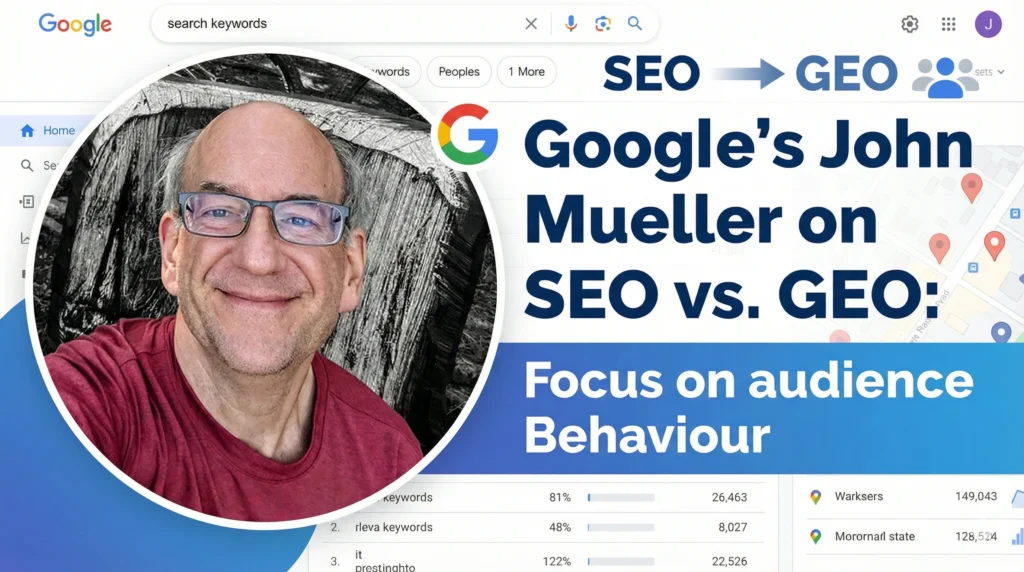
The digital marketing world thrives on new terminology. In recent months, as generative artificial intelligence has fundamentally altered the way users interact with search engines, a new debate has emerged: Is traditional Search Engine Optimization (SEO) still sufficient, or must marketers pivot to Generative Engine Optimization (GEO)?
This critical question was recently posed by a Reddit user, prompting a definitive response from Google Search Advocate, John Mueller. His answer cuts through the industry hype, urging marketers to bypass the semantics and focus on the practical reality of audience behavior and business priorities.
Mueller’s perspective is clear: labeling a discipline “SEO” or “GEO” is less important than understanding the “full picture” of referred traffic and where consumers are actually spending their time. If an online business relies on referred traffic for revenue, a pragmatic, data-driven approach is essential for prioritizing investment.
The core message from Google’s senior leadership is that while the medium (search results vs. AI summaries) may change, the underlying requirements for high-quality, authoritative content remain the same. However, this does not grant businesses permission to ignore the profound changes brought by AI. It demands a realistic evaluation of current usage metrics to determine where resources should be allocated.
Understanding the SEO vs. GEO Debate
The concept of Generative Engine Optimization (GEO) arose directly from the rollout of features like Google’s Search Generative Experience (SGE) and AI Overviews. These tools fundamentally change the traditional search engine results page (SERP) experience. Instead of a list of ten blue links, users often receive an immediate, synthesized answer generated by a Large Language Model (LLM).
For many marketers, this shift provoked anxiety. If an AI summary provides the answer directly, how will users find and click through to the original source? GEO was conceptualized as a specialized discipline focused on optimizing content specifically so that it is easily understood, retrieved, and summarized by these underlying AI models.
The Permanent Presence of AI in Search
While Mueller refused to engage in the academic debate over whether GEO is a distinct discipline, he offered a non-negotiable fact: AI is not a temporary trend. It is a fundamental, permanent alteration to the way information is accessed and consumed online.
Mueller explicitly stated: “What you call it doesn’t matter, but ‘AI’ is not going away.”
This means that regardless of whether a business adopts the “GEO” label, thinking strategically about how a website’s value translates into an AI-driven environment is crucial for long-term viability. The methods used to optimize for a traditional search index and the methods required for visibility within a generative model may share significant overlap, but ignoring the presence of AI features is no longer an option.
Read More: How to Find a Good SEO Consultant
Google’s Consistent Stance: Good SEO is Inherently Good GEO
John Mueller’s view aligns perfectly with the consistent messaging delivered by other high-ranking Google officials. The company has repeatedly pushed back against the idea that optimizing for AI should be treated as an entirely separate endeavor requiring a completely new set of tactics.
The reasoning behind this unified message is straightforward: AI models, including the ones powering SGE and AI Overviews, source their information from the existing public web index. They are designed to draw upon the highest-quality, most authoritative, and reliable information available—the very same benchmarks that successful traditional SEO practices have emphasized for years.
Several key statements from Google leadership underscore this point:
- Danny Sullivan on Overlap: Google’s Public Liaison for Search, Danny Sullivan, has famously summarized the connection, stating that ‘Good SEO is good GEO.’ This suggests that content meeting high standards for traditional SEO (e.g., excellent structure, depth, authoritativeness) is naturally suited for effective summarization by AI models.
- Ranking for AI Overviews: Google has confirmed that the general principles of SEO are effective for ranking and appearing within AI Overviews. There is no secret, separate optimization strategy or technical file (like an LLMS.txt) required to participate in the generative experience.
- Robby Stein on Synergy: Google VP Robby Stein noted that the processes for traditional SEO and AI search optimization exhibit “a lot of overlap,” reinforcing the idea that they are not mutually exclusive.
In essence, Google views SEO as the foundational discipline. If content adheres to established best practices—focusing on user experience, comprehensive coverage, and demonstrating high levels of Experience, Expertise, Authoritativeness, and Trustworthiness (E-E-A-T)—it is already optimized for generative models.
The Crucial Mandate: Prioritizing Investment Based on Reality
While Mueller validates the importance of considering AI, his most vital piece of advice centers on data and realism. For marketers facing finite resources, the proliferation of new channels and potential optimization vectors can lead to paralysis or, worse, investment in the wrong areas.
Mueller urged the community to “Be realistic and look at actual usage metrics and understand your audience.”
This perspective shifts the focus away from abstract theoretical optimization and toward practical resource allocation. Marketers must ask fundamental, business-driven questions:
- How large is the segment of our audience that currently uses AI tools (like SGE, ChatGPT, or other LLMs) to find information relevant to our business?
- How does the volume of traffic and conversion potential from AI usage compare to established channels like traditional organic search, paid search, social media, or email marketing?
- Based on these usage metrics, where should we dedicate our limited time, budget, and content production resources?
For example, if a business generates 60% of its revenue from traditional Google organic search and 30% from Facebook referrals, but data indicates that less than 2% of potential customers interact with AI-generated answers relevant to their product, drastically shifting the entire marketing budget to “GEO” would be an irrational business decision.
Analyzing Audience Behavior Beyond the SERP
To follow Mueller’s advice, digital publishers and marketers need to evolve their analytics framework. Understanding audience behavior means moving beyond simple search ranking reports and delving into complex traffic segmentation.
As AI Overviews become standard, tracking how traffic is classified in tools like Google Analytics and Google Search Console is vital. Are clicks from AI summaries categorized differently? If not, how can specific content wins (i.e., appearing in a synthesized response) be measured against standard blue-link clicks?
Furthermore, the marketer must track the broader context of customer journeys. If the target audience primarily consists of older professionals who rely on email newsletters, optimizing solely for niche AI search queries might yield low returns compared to perfecting email deliverability and subject line optimization.
Read More: On-Page SEO Factors That Directly Impact Rankings
The Impact of Referred Traffic and Revenue Generation
Mueller specifically highlights the needs of businesses that rely on “referred traffic” to generate revenue. This includes most content publishers, e-commerce sites, affiliate marketers, and lead generation businesses.
In the traditional SEO model, visibility (ranking) directly correlated with potential traffic (clicks) and subsequent revenue. The advent of generative AI introduces a critical divergence: high visibility in the AI summary (i.e., being cited as the source) does not automatically guarantee high referred traffic. The AI may satisfy the user’s query directly, removing the need for a click.
This complexity is why considering the “full picture” is paramount. A holistic approach demands optimizing for both direct clicks (traditional SEO) and citation/brand visibility (GEO principles). If content is summarized, the goal shifts to ensuring the brand name, product name, or a strong call-to-action is prominently included in the AI response, encouraging a follow-up action or branded search.
Strategic Prioritization in the AI Era
Prioritizing accordingly means making tough choices based on the likely return on investment (ROI). Marketers must continually evaluate two critical factors:
- Traffic Volume Potential: How many potential users are using this new AI channel today, and what is the projected growth trajectory?
- Conversion Quality: Is the traffic derived from AI summaries high-quality, or is it merely passive engagement? Does it lead to conversions or sales at a rate comparable to organic search traffic?
If the data shows low current AI usage but massive projected growth among a core target demographic, a sensible strategy would be to dedicate a small, experimental budget to optimizing for generative visibility while maintaining heavy investment in proven channels.
Tactical Overlap: Applying SEO Best Practices to the Generative Index
The reason why traditional SEO tactics are effective in the age of AI lies in the core mission of both disciplines: delivering the best possible answer efficiently.
To succeed under both SEO and GEO mandates, marketers should focus on established practices that specifically aid machine interpretation and summarization:
1. Enhanced E-E-A-T Signaling
AI models prioritize information from trusted sources. Ensuring content writers have clear biographies, credentials, and evidence of genuine expertise is crucial. For AI, E-E-A-T acts as a filter; the better the E-E-A-T signal, the higher the likelihood the content will be selected for inclusion in a comprehensive summary.
2. Clear Structural and Semantic Markup
Generative AI thrives on well-organized content. Utilizing clear <h2> and <h3> headings, bulleted and numbered lists, and concise paragraphs makes it easier for the model to extract key data points. Optimization for AI means making the content highly scannable, not just for humans, but for algorithms designed to synthesize information quickly.
3. Implementing Comprehensive Structured Data
Schema markup (structured data) provides explicit signals to search engines and AI models about the type of content present (e.g., Recipe, FAQ, Product, HowTo). This explicit communication minimizes ambiguity and maximizes the chance of the content being accurately utilized in AI Overviews or knowledge panel responses.
4. Addressing User Intent Directly
Traditional SEO focuses on matching content to user intent. This is even more vital for GEO. Content that directly and definitively answers a query without unnecessary fluff is inherently more valuable to a summarizing AI model than verbose, meandering text. The AI is looking for the “golden nugget” answer; providing it early and clearly is the best form of optimization.
Read More: How to find the best AI Consultant for Your Business
Conclusion: Data Over Dogma in Digital Marketing
John Mueller’s contribution to the SEO vs. GEO discussion serves as a powerful reminder that digital marketing success is rooted in adaptation and measurable results, not in embracing trendy new labels.
The debate over whether “GEO” replaces “SEO” is largely academic. As Mueller correctly asserts, AI is an indelible part of the digital ecosystem, and every business that relies on online traffic must account for it. However, the decision on how heavily to invest in optimizing for generative models must be a strategic one, dictated by actual usage statistics and the demonstrated behavior of the target audience.
For online businesses focused on generating revenue from referred traffic, the mandate is clear: adopt a holistic view of the digital marketing landscape. Leverage the established best practices of SEO, recognize the permanent presence of AI, and use rigorous data analysis to prioritize time and resources where they will yield the greatest return.
Good digital strategy remains good business strategy: understand your customer, measure everything, and invest in the channels that deliver tangible value.