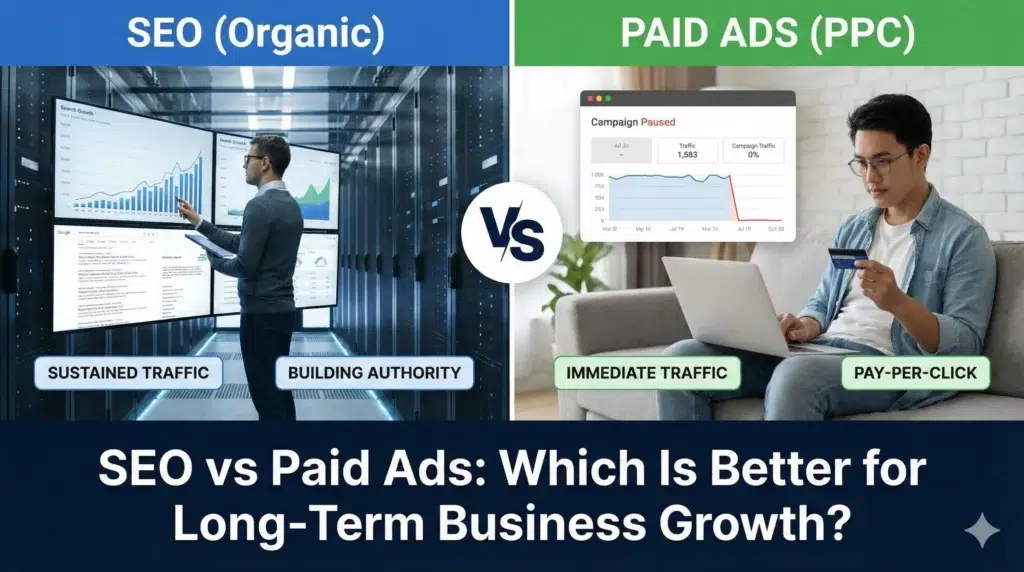
When planning your digital marketing strategy, one question consistently surfaces: should you invest in SEO or paid ads? Both approaches drive traffic to your website, but they operate differently and produce distinct results over time.
This comparison examines search engine optimization and pay-per-click advertising to help you determine which aligns better with your business goals—or whether combining both makes the most sense.
Understanding the Core Differences
Search Engine Optimization (SEO) focuses on improving your website’s organic visibility in search results. You’re optimizing content, technical elements, and building authority so search engines rank your pages higher naturally.
Pay-Per-Click (PPC) Advertising, including Google Ads, puts your business at the top of search results through paid placements. You bid on keywords and pay each time someone clicks your ad.
The fundamental distinction? SEO requires time and consistent effort to build momentum, while PPC delivers immediate visibility as soon as your campaign goes live.
Cost Analysis: Investment vs. Ongoing Spend
SEO Investment Structure
SEO demands upfront investment in content creation, technical improvements, and link building. You might spend on:
- Content writers and editors
- SEO specialists or agencies
- Website development and optimization
- Tools for keyword research and performance tracking
Once your content ranks well, it continues generating traffic without additional payment per click. Your initial investment compounds over time as you build a library of ranking content.
PPC Cost Model
Google Ads operates on a direct payment system. Your costs include:
- Ad spend (cost per click × number of clicks)
- Campaign management fees
- Creative development for ad copy and landing pages
- Testing and optimization tools
Traffic stops the moment you pause your budget. In competitive industries, CPCs can reach $50-100 or more per click, making sustained campaigns expensive.
Long-term perspective: SEO typically becomes more cost-effective after 6-12 months as organic rankings improve. PPC maintains consistent costs that scale linearly with your traffic goals.
Timeline: Quick Wins vs. Sustainable Growth
PPC Speed Advantages
Paid ads deliver results within hours. Launch a campaign in the morning, and you’ll see clicks by afternoon. This speed benefits:
- New product launches requiring immediate attention
- Seasonal promotions with tight windows
- Testing new markets before committing resources
- Businesses needing instant lead generation
SEO’s Gradual Build
Organic rankings take 3-6 months minimum to show meaningful results, often longer in competitive niches. Google needs time to:
- Crawl and index your new content
- Assess your content quality and relevance
- Compare your pages against established competitors
- Build trust in your domain authority
However, once you achieve strong rankings, they tend to remain stable with proper maintenance. Your position becomes increasingly difficult for competitors to displace.
Traffic Quality and User Intent
Organic Search Benefits
Users often trust organic results more than ads. Studies show that organic listings receive approximately 70% of clicks on search results pages, while ads capture the remaining 30%.
People searching organically demonstrate research behavior and often sit higher in the consideration phase. They’re actively looking for information, comparing options, and making informed decisions.
Paid Ad Advantages
PPC allows precise targeting of high-intent keywords that might be difficult to rank for organically. You can appear for:
- Competitor brand names
- High-value commercial terms
- Specific product searches
- Local service queries with immediate need
Your ad copy can directly address pain points and include strong calls-to-action, potentially improving conversion rates despite lower overall trust.
Control and Flexibility
PPC’s Immediate Adjustments
Paid campaigns offer complete control:
- Turn campaigns on or off instantly
- Adjust budgets daily based on performance
- Test multiple ad variations simultaneously
- Target specific demographics, locations, and devices
- Schedule ads for optimal times
This flexibility allows rapid response to market changes, seasonal demand, or budget constraints.
SEO’s Strategic Patience
Organic optimization requires commitment to long-term strategy:
- Content changes take weeks to reflect in rankings
- Algorithm updates can impact visibility unexpectedly
- Recovery from ranking drops requires sustained effort
- Building domain authority spans months or years
You’re playing a long game, but the payoff includes compounding benefits that don’t disappear when you pause efforts.
Competitive Landscape Considerations
When SEO Makes Sense
Strong organic visibility works best when:
- Your industry has reasonable competition levels
- You can produce high-quality, differentiated content
- Your target audience conducts extensive research
- You’re building a brand for sustained market presence
- Budget constraints limit sustained paid campaigns
When PPC Performs Better
Paid ads excel when:
- Competition makes organic ranking extremely difficult
- You need results before SEO momentum builds
- Profit margins support ongoing ad spend
- You’re targeting bottom-funnel, ready-to-buy keywords
- Testing new offerings before committing to content investment
Conversion Performance
SEO Conversion Patterns
Organic traffic often converts at lower rates initially but demonstrates higher lifetime value. Users who find you through organic search:
- Tend to conduct more research
- Return multiple times before converting
- Show higher engagement metrics
- Demonstrate better brand recall
Your content educates and builds trust before the sale, creating informed customers who understand your value.
PPC Conversion Dynamics
Paid ads can achieve higher immediate conversion rates when properly optimized:
- Landing pages match ad messaging precisely
- You target bottom-funnel keywords
- Offers create urgency
- The path to purchase is streamlined
However, these users may show less brand loyalty since they clicked based on ad positioning rather than organic discovery.
Measuring Success: Key Metrics
SEO Performance Indicators
Track these metrics for organic success:
- Organic traffic growth
- Keyword rankings for target terms
- Click-through rates from search results
- Pages indexed by search engines
- Domain authority scores
- Backlink profile quality
- Content engagement metrics
Success builds gradually, so measure progress monthly and quarterly rather than daily.
PPC Performance Metrics
Monitor these factors for paid campaigns:
- Cost per click (CPC)
- Click-through rate (CTR)
- Conversion rate
- Cost per acquisition (CPA)
- Return on ad spend (ROAS)
- Quality Score
- Impression share
You can assess PPC performance daily or weekly, making rapid optimization possible.
The Case for Integration
Most successful businesses don’t choose exclusively between SEO and PPC—they use both strategically.
Complementary Benefits:
- Use PPC data to inform SEO: Test keywords through paid ads to identify high-converters before investing in content creation
- Fill SEO gaps with paid ads: Run campaigns for keywords where organic ranking proves too competitive or time-consuming
- Dominate search results: Appear in both paid and organic positions to capture maximum visibility and build brand authority
- Support new content: Run ads to promote new content while SEO gains traction organically
- Retarget organic visitors: Use paid ads to bring back people who visited through organic search but didn’t convert
Read More: How to Find a Good SEO Consultant
Making Your Decision
Choose SEO as your primary focus if you:
- Want sustainable, long-term traffic growth
- Have time to wait 6-12 months for results
- Can invest in quality content creation
- Operate in a market where you can reasonably compete
- Prefer lower ongoing costs after initial investment
Prioritize PPC advertising if you:
- Need immediate traffic and conversions
- Have budget for sustained ad spend
- Operate in extremely competitive organic markets
- Want precise control over targeting and messaging
- Run time-sensitive campaigns or promotions
Implement both strategies when you:
- Have adequate budget for comprehensive marketing
- Want maximum search visibility
- Need short-term results while building long-term assets
- Can use data from one channel to improve the other
- Aim for market leadership in your space
Real-World Application
Consider a new e-commerce store selling sustainable home goods:
Year 1 Strategy: Heavy PPC investment drives immediate sales and provides data on which products resonate. Meanwhile, begin building SEO foundations with product descriptions, blog content about sustainability, and technical optimization.
Year 2 Strategy: Organic content starts ranking for informational queries, bringing in research-phase customers. Reduce PPC budget for terms where organic ranking improves. Focus paid ads on high-value commercial terms and remarketing.
Year 3+: Strong organic presence handles most traffic needs. PPC budget shifts to new product launches, seasonal campaigns, and maintaining visibility for ultra-competitive terms.
The Verdict on Long-Term Growth
For sustained business growth, SEO provides superior long-term value. Your investment compounds over time, creating assets that continue producing results years later. You build brand authority, trust, and a traffic source that doesn’t disappear when budgets tighten.
However, SEO alone leaves opportunity on the table. Paid ads deliver immediate results, provide valuable market intelligence, and allow you to compete for visibility that organic search can’t capture quickly.
The businesses that win long-term combine both approaches strategically—using PPC for quick wins and data collection while building SEO assets that drive sustainable growth.
Start where your business needs are most urgent, but develop a roadmap that incorporates both. Your specific balance depends on your industry, competition, budget, and timeline—but the goal remains the same: consistent, profitable customer acquisition that scales with your business.