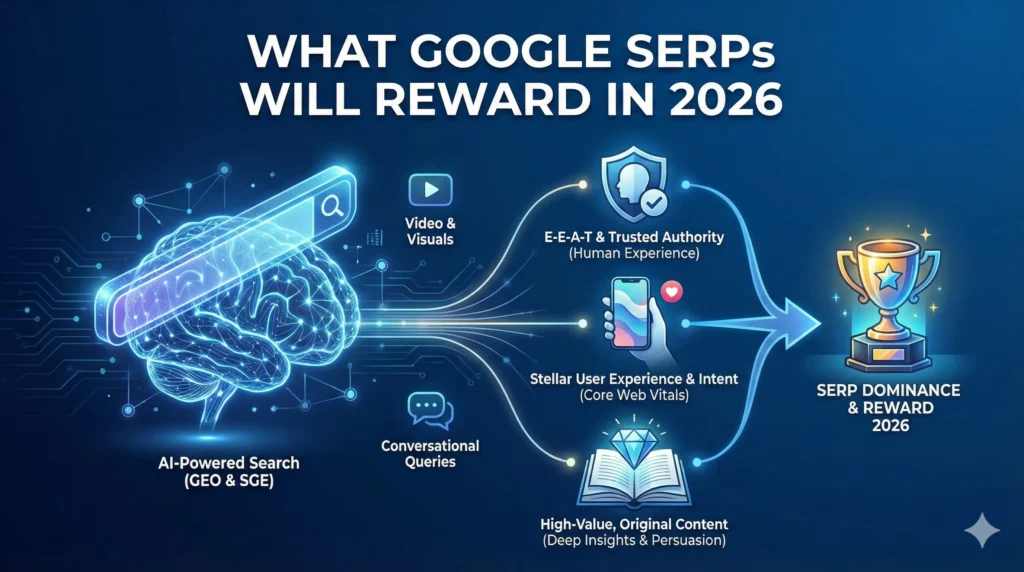
Google’s Search Engine Results Pages (SERPs) are in a state of continuous, accelerated transformation. For years, the evolution of search was characterized by incremental updates to ranking algorithms. Today, however, we are witnessing a fundamental shift—a revolution driven by generative Artificial Intelligence (AI) and deep machine learning integrations. As we look toward 2026, the challenge for SEO leaders is no longer merely keeping up with daily updates, but understanding which macroscopic changes genuinely impact organic traffic and revenue generation.
The traditional rules of search engine optimization are being rewritten, forcing digital publishers and marketing professionals to reconsider their entire content and technical strategies. The introduction and rapid expansion of features like AI Overviews, the implementation of ‘AI Mode,’ and constant experimentation with SERP layouts mean that the landscape of organic visibility is becoming increasingly dynamic and complex. To maintain competitive advantage, SEO strategies must evolve from reaction to anticipation, prioritizing the signals Google is clearly preparing to reward in the near future.
The Rise of AI Overviews and the SERP Fragmentation
Perhaps the most significant change shaping the 2026 SERP is the full integration and maturation of generative AI features. What began as an experimental interface in the Search Generative Experience (SGE) environment has rapidly coalesced into permanent features that fundamentally alter how users interact with search results.
The New Gatekeeper: AI Overviews
AI Overviews (AIOs) have moved from novel distractions to dominant components of the SERP, expanding across various keyword and intent types. These summarized, AI-generated answers, often displayed at the very top of the page, are designed to fulfill user intent directly within the search interface.
The strategic challenge posed by AIOs is twofold. First, they accelerate the trend of zero-click searches, where users find their answers without ever visiting a website, potentially cannibalizing high-volume informational traffic. Second, being featured in an AI Overview—often with source citations—requires an elevated level of content trust and authority. Google’s AI models must deem a source highly reliable, accurate, and relevant to synthesize an answer.
For SEO professionals, success in 2026 means optimizing not just for relevance, but for ‘summarizability.’ Content must be structured logically, backed by clear evidence, and demonstrate high levels of E-E-A-T (Experience, Expertise, Authoritativeness, and Trustworthiness) to be selected as a preferred source by the generative engine.
Deconstructing ‘AI Mode’ and Intelligent Ranking
The term ‘AI Mode’ describes the increasingly complex, personalized environment that Google is building behind the scenes. This is less about a visual feature and more about the ranking philosophy itself. AI Mode signifies a move away from rigid, keyword-matching algorithms toward a context-aware system that leverages deep learning to understand user intent, personal history, and real-time context to deliver a hyper-personalized result set.
This level of personalization complicates conventional SEO tracking. Two users searching the same query on the same device might see vastly different results based on their inferred interests and history. In this highly individualized environment, keyword targeting needs to shift towards covering comprehensive semantic entities and catering to broad user journeys, rather than optimizing narrowly defined, singular keyword strings. Search results are no longer uniform; they are reflections of individual need.
SERP Layout: Beyond the Blue Links
The structure of the SERP itself is perhaps the most visible area of ongoing experimentation. The classic page of ten organic links is an anachronism. In 2026, the SERP is a fragmented canvas of specialized units, all competing for the user’s gaze.
The Shrinking Visibility of Traditional Organic Listings
As Google incorporates more diverse elements, the actual organic blue links are pushed further down the page. The increased density of specialized SERP features means that SEO success is increasingly defined by placement *within* a feature, rather than placement *below* the features.
These specialized units include:
1. **Rich Results and Structured Data:** The reward for using schema markup effectively continues to grow. Elements like FAQ snippets, How-To guides, Review stars, and specialized recipe or product cards dominate the above-the-fold space. These are direct pathways for content to jump the queue.
2. **Visual and Multimedia Results:** Video carousels, image packs, and even short-form video snippets (often pulled from sources like YouTube or TikTok) are integrated into the main feed. Optimization for these formats requires dedicated video SEO and image optimization strategies.
3. **Vertical Search Integrations:** Google’s specialized searches (Maps, Shopping, Flights, News) are being woven more tightly into the main SERP. For retail businesses, getting found in the Google Shopping carousel is often more valuable than achieving a top-three organic ranking. Similarly, local service providers must prioritize Google Business Profile optimization to appear prominently in the Maps pack.
The critical takeaway for digital publishers is the necessity of adopting a multi-format, multi-modal content strategy. Relying solely on text documents will severely limit organic visibility when video, audio, and visually rich snippets are prioritized.
The New Signals Driving Organic Traffic in 2026
With search evolving so rapidly, SEO leaders must utilize data-backed analysis—such as the insights shared by experts like Tom Capper of STAT Search Analytics—to filter out the noise and identify the signals that genuinely influence click-through rates and long-term organic traffic health.
The Unassailable Mandate of E-E-A-T
In a world where AI synthesizes answers and creates content, the differentiation factor for human-created sources is absolute trust. E-E-A-T is not merely a ranking factor; it is the currency of visibility in the generative AI era. Google needs high-quality, verifiable sources to feed its AI models and maintain its reputation for accuracy.
Content that wins in 2026 will demonstrate:
* **Experience:** Evidence that the author or organization has direct, verifiable experience with the topic (e.g., product reviews by actual users, tutorials written by practitioners).
* **Expertise:** Deep, specialized knowledge that goes beyond basic summarization, often cited by industry peers or academic sources.
* **Authoritativeness:** Recognition by others in the field (backlinks from authoritative sites, mentions in respected publications).
* **Trustworthiness:** Factual accuracy, transparency (clear authorship, contact info), security, and a positive reputation.
This emphasis means SEO is becoming inextricably linked with public relations, brand management, and content operations. The technical SEO foundation must be flawless, but the content layer must exhibit impeccable authority.
User Experience and Intent Satisfaction
While Core Web Vitals (CWVs) remain important for page experience, the overall concept of “good user experience” has broadened. Google SERPs now demand content that satisfies intent quickly and comprehensively, regardless of whether that satisfaction occurs on the SERP itself (via AIO) or on the destination page.
The metrics that matter now relate to how efficiently the user journey is completed. If a user clicks an organic link, does the page deliver exactly what was promised? If the bounce rate from an organic click is high, Google may interpret that as a failure to satisfy intent, even if the content itself is technically sound.
In 2026, optimization for intent satisfaction requires deep audience analysis. SEO teams must go beyond knowing the keyword; they must understand the true motivation behind the query, anticipating follow-up questions, and organizing content for maximum findability and clarity.
Strategic Adaptation for the Future-Proofed SEO Campaign
To successfully navigate the dynamic SERP environment leading up to 2026, SEO strategies must undergo a fundamental reorientation, shifting focus from tactical keyword wins to holistic entity and authority development.
Shift 1: From Keyword Optimization to Entity Optimization
Traditional SEO focused on optimizing pages for specific keywords. The future lies in optimizing for *entities*—people, places, things, and concepts—that Google recognizes and links together in its Knowledge Graph.
To optimize for entities:
1. **Comprehensive Coverage:** Ensure your content fully addresses all related aspects of an entity. If you are writing about a console game, cover its characters, developers, plot, and technical specifications, establishing your page as the definitive hub for that entity.
2. **Semantic Linkages:** Use internal and external linking to connect your entity content with other recognized entities, helping Google establish the context and authority of your subject matter.
3. **Structured Data Integration:** Use schema markup (especially `About` and `Mentions` properties) to explicitly signal the entities your content covers.
This approach ensures that regardless of how the SERP shifts—whether an AI Overview pulls a definition or a Knowledge Panel displays facts—your content is the authoritative source linked to that primary entity.
Shift 2: Focusing on Content Depth Over Content Volume
The era of producing high volumes of low-quality, keyword-stuffed content is definitively over. Generative AI makes basic, surface-level content instantly available. What remains scarce and valuable is deep, proprietary insight, original data, and unique perspectives that only human experts can provide.
SEO investment in 2026 should prioritize:
* **Original Research:** Conducting surveys, compiling proprietary data, or performing unique tests that result in first-hand findings.
* **Author Credentials:** Highlighting the real-world credentials of content creators, including detailed author biographies and bylines.
* **Unconventional Angles:** Providing specialized answers to long-tail, complex, and niche queries that AI Overviews struggle to synthesize accurately.
Shift 3: Mastering Non-Text SEO and Multimedia
Given the increasing prominence of video carousels and image packs, a successful 2026 strategy must allocate significant resources to non-text SEO. This involves:
* **Video Optimization:** Ensuring all video content is accurately transcribed, correctly tagged, and hosted optimally (often via YouTube) to facilitate discovery by Google’s video ranking systems.
* **Image Metadata:** Utilizing descriptive alt text, captions, and proper file names for all visuals, enabling images to appear in visual search results and rich snippets.
* **Audio/Podcast SEO:** Exploring methods to make audio content crawlable and indexable, capturing voice search opportunities.
The Imperative of Data-Driven Adaptability
The rapid changes highlighted by the expansion of AI Overviews and the deployment of AI Mode underscore a critical organizational requirement: agility in data analysis. For SEO leaders, the biggest challenge is accurately measuring the impact of these changes.
When organic visibility is fragmented across specialized units and traffic is suppressed by zero-click AI answers, standard ranking reports become insufficient. Success in 2026 hinges on:
1. **Comprehensive SERP Feature Tracking:** Utilizing advanced analytics platforms that can track performance not just for the ‘blue links,’ but specifically within AI Overviews, People Also Ask boxes, video carousels, and local packs.
2. **Attribution Modeling:** Developing sophisticated models that accurately attribute revenue and conversions not just to the final click, but to the holistic user journey, recognizing the influence of branded searches driven by AI source citations.
3. **Competitive Intelligence:** Continuously monitoring which competitors are successfully capturing AI Overview placements and rich results. Understanding their content structure and authority profile provides the blueprint for adaptation.
By focusing on these data points, SEO professionals can move beyond merely reacting to algorithm updates and instead predict and shape their strategies based on the underlying changes, features, and signals that will truly drive organic traffic in 2026. The future of search is volatile, but armed with data and a commitment to high-quality authority, digital publishers can secure their place at the top of the evolving SERP.