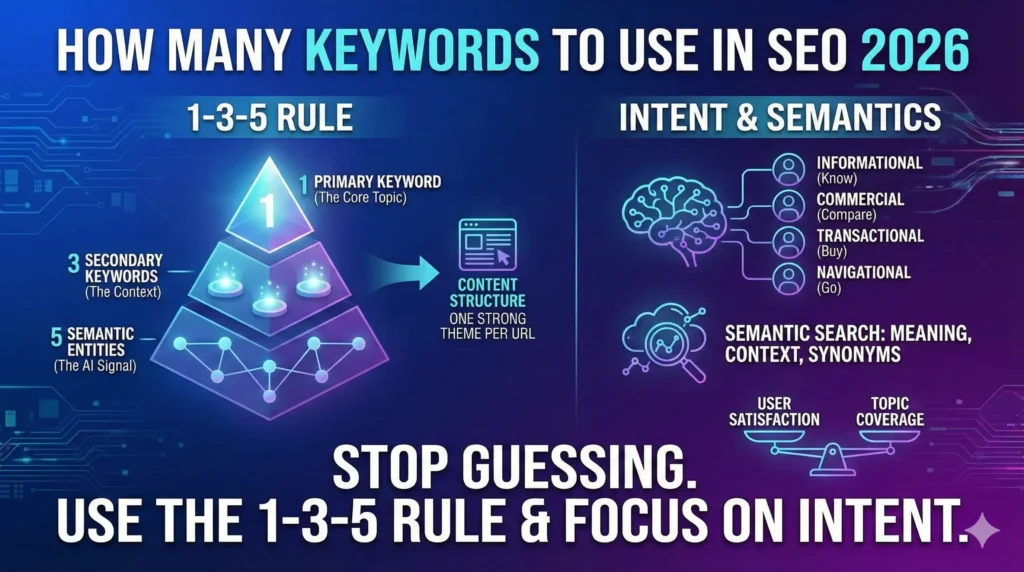
Getting keyword strategy right can make or break your SEO performance. Too few keywords limit your reach. Too many dilute your focus and confuse search engines about your page’s purpose.
This guide breaks down exactly how many keywords you should target—per page, per website, and across your entire content strategy—with practical examples you can apply immediately.
Understanding Keyword Types First
Before counting keywords, recognize that not all keywords function the same way:
Primary Keyword: The main search term your page targets. This is the core topic and usually appears in your title, URL, and first paragraph.
Secondary Keywords: Related terms that support your primary keyword. These add depth and help you rank for variations of your main topic.
LSI Keywords (Latent Semantic Indexing): Contextually related terms that help search engines understand your content’s meaning. Think synonyms and naturally related phrases.
Long-Tail Keywords: Longer, more specific phrases with lower search volume but higher conversion potential.
Each type serves a specific purpose in your overall strategy.
Keywords Per Page: The Golden Rules
One Primary Keyword Per Page
Rule #1: Target exactly one primary keyword per page. This keeps your content focused and prevents keyword cannibalization—where multiple pages compete for the same rankings.
Example: If you’re writing about “email marketing automation,” that’s your primary keyword. Don’t try to also target “social media marketing” on the same page. Create separate pages for distinct topics.
Why this matters: Google wants to deliver the most relevant result for each search query. A page with clear focus ranks better than one trying to cover everything.
2-5 Secondary Keywords Per Page
Support your primary keyword with 2-5 closely related secondary terms. These should be:
- Natural variations of your main topic
- Related questions people ask
- Supporting concepts necessary to explain your main topic
Example for “email marketing automation”:
- Primary: email marketing automation
- Secondary: automated email campaigns, marketing automation software, email workflow automation, drip campaign automation
These terms naturally fit into comprehensive content without forcing awkward repetition.
10-20 LSI Keywords Throughout
Include 10-20 contextually related terms naturally throughout your content. Don’t count or force these—they should appear organically as you write thorough, helpful content.
Example LSI keywords for email marketing automation:
- Subscriber segmentation
- Campaign triggers
- Marketing funnel
- Lead nurturing
- Email sequences
- Customer journey
- Conversion tracking
- A/B testing
- Email deliverability
Google’s algorithm recognizes these terms as proof you’re covering the topic comprehensively.
Keyword Density: The Outdated Metric
Forget about keyword density percentages. The old rule of “use your keyword 2-5% of the time” no longer applies.
Modern approach: Write naturally and include your primary keyword:
- In your title tag
- In your URL
- In your first 100 words
- In at least one H2 heading
- A few times naturally throughout the body
- In your meta description
If your content is 1,500 words, your primary keyword might appear 5-8 times. If it’s 3,000 words, maybe 10-15 times. Let the natural flow of writing determine frequency.
Warning sign: If you’re consciously counting keyword mentions, you’re probably overusing them. Modern SEO rewards natural, reader-focused writing.
Keywords Per Website: Building Your Content Strategy
Small Business or Blog (10-50 pages)
Total keyword targets: 30-150 keywords
Start with:
- 10-15 primary topics (one page each)
- 3-5 secondary keywords per page
- Total: 40-75 keyword variations
Example for a local bakery:
- Birthday cakes in [city] (primary)
- Custom birthday cake designs (secondary)
- Kids birthday cakes (secondary)
- Adult birthday cake ideas (secondary)
Repeat this structure across your core offerings and informational content.
Medium-Sized Business (50-200 pages)
Total keyword targets: 150-600 keywords
Expand to:
- 50-100 primary topics
- Multiple content types (product pages, category pages, blog posts, guides)
- 3-6 secondary keywords per page
At this scale, organize keywords into topic clusters around your core services or products.
Large Enterprise or Authority Site (200+ pages)
Total keyword targets: 600-10,000+ keywords
Build comprehensive coverage with:
- Hundreds of primary topics
- Deep content clusters
- Location-specific pages
- Multiple content formats
- Regular publishing schedule adding new keywords
Large sites can realistically target thousands of keywords by creating high-quality content around every relevant search query in their industry.
Content Type Determines Keyword Count
Homepage
Keyword focus: 1 primary (your brand/main offering) + 3-5 secondary (your core services)
Your homepage introduces your business broadly. Don’t try to rank for everything here—that’s what internal pages do.
Product or Service Pages
Keyword focus: 1 primary (the specific product/service) + 2-4 secondary (variations, features, benefits)
Example for “women’s running shoes”:
- Primary: women’s running shoes
- Secondary: ladies athletic footwear, women’s jogging sneakers, female running trainers
Blog Posts
Keyword focus: 1 primary + 3-5 secondary + abundant LSI keywords
Blog content allows more flexibility. You’re answering questions and providing value, which naturally incorporates more keyword variations.
Category Pages
Keyword focus: 1 primary (the category) + 4-8 secondary (subcategories and variations)
Example for “kitchen appliances”:
- Primary: kitchen appliances
- Secondary: small kitchen appliances, modern kitchen appliances, electric kitchen tools, home cooking equipment
Location Pages
Keyword focus: 1 primary (service + location) + 2-3 secondary (location variations, service variations)
Example: “plumber in Austin Texas” + “Austin plumbing services,” “emergency plumber Austin,” “local Austin plumber”
How to Research the Right Number of Keywords

Step 1: Start With Your Core Topics
List 5-10 main topics your business covers. These become your primary keyword categories.
Step 2: Expand Each Topic
For each core topic, find:
- 1 primary keyword (highest volume, most relevant)
- 5-10 secondary keywords (related searches, question variants)
- 10-20 LSI keywords (natural context terms)
Tools like Google’s “People Also Ask” and “Related Searches” provide excellent keyword ideas.
Step 3: Assess Search Volume and Competition
Don’t just target high-volume keywords. Balance your portfolio:
- High volume (10,000+ monthly searches): Competitive, worth pursuing for established sites
- Medium volume (1,000-10,000 searches): Sweet spot for most businesses
- Low volume (100-1,000 searches): Easier to rank, highly specific, often better conversion rates
Step 4: Map Keywords to Existing or New Pages
Create a spreadsheet:
- Column 1: Page/URL
- Column 2: Primary keyword
- Column 3-7: Secondary keywords
- Column 8: Notes on LSI keywords to include
This mapping prevents keyword cannibalization and ensures strategic coverage.
Keyword Cannibalization: The Hidden Problem
What happens: You create multiple pages targeting the same or very similar keywords. Google doesn’t know which page to rank, so both perform poorly.
Example of cannibalization:
- Page 1: “best email marketing software”
- Page 2: “top email marketing tools”
- Page 3: “email marketing software comparison”
These are too similar. Google sees them as competing, not complementary.
Solution: Consolidate similar keywords onto one comprehensive page, or differentiate clearly:
- Page 1: “email marketing software for small business”
- Page 2: “email marketing software for ecommerce”
- Page 3: “free email marketing software”
Now each page has a distinct purpose and target audience.
Adding Keywords Over Time
Don’t try to target all your keywords at once. Build systematically:
Month 1-3: Foundation
- Create 10-15 core pages
- Target your highest-priority keywords
- Focus on quality over quantity
Month 4-6: Expansion
- Add 15-20 supporting pages
- Target medium-competition keywords
- Build topic clusters around core pages
Month 7-12: Depth
- Create 20-30 detailed content pieces
- Target long-tail variations
- Fill content gaps
Year 2+: Authority
- Continuously add new content
- Update existing pages with fresh information
- Target increasingly competitive terms as domain authority grows
Quality Over Quantity Always Wins
Here’s the truth: One page targeting 1 primary + 3 secondary keywords that ranks well beats 10 pages targeting 50 keywords that don’t rank at all.
Better approach:
- Create fewer, higher-quality pages
- Research keywords thoroughly
- Write comprehensive content
- Build links to strengthen those pages
- Update and improve over time
This focused strategy outperforms scattering effort across hundreds of thin pages.
Practical Keyword Count Recommendations by Goal
Goal: Establish Basic Online Presence
- Total keywords: 20-50
- Pages needed: 10-15
- Timeline: 3-6 months
Perfect for local businesses, startups, or simple service providers.
Goal: Compete in Your Local Market
- Total keywords: 50-150
- Pages needed: 25-50
- Timeline: 6-12 months
Includes location-specific pages, service variations, and supporting content.
Goal: Rank Nationally for Competitive Terms
- Total keywords: 200-500
- Pages needed: 75-150
- Timeline: 12-24 months
Requires comprehensive topic coverage, regular content creation, and link building.
Goal: Dominate Your Industry
- Total keywords: 500-2,000+
- Pages needed: 200-500+
- Timeline: 24-36 months
Built through consistent publishing, topic authority, and market leadership content.
Common Keyword Count Mistakes
Mistake 1: Targeting Too Many Keywords Per Page
Trying to rank for 10+ different primary topics on one page confuses search engines and dilutes your message. Stick to 1 primary + a few secondary terms.
Mistake 2: Not Enough Keyword Variation
Targeting only exact-match keywords misses opportunities. Include question formats, natural language variations, and related concepts.
Mistake 3: Ignoring Search Intent
Keywords with different intent need different pages:
- “what is email marketing” (informational)
- “email marketing software comparison” (commercial investigation)
- “buy Mailchimp subscription” (transactional)
Don’t try to serve all these intents on one page.
Mistake 4: Keyword Stuffing Headers
Don’t force your primary keyword into every H2 and H3. Use variations, questions, and natural language that serves your readers.
The Bottom Line: Your Keyword Strategy
Per page: 1 primary keyword + 2-5 secondary keywords + natural use of related terms
For your website: Start with 30-50 total keyword targets across 10-15 pages, then expand systematically
Over time: Add 5-10 new keyword targets monthly through fresh content and page updates
Success metric: Focus on ranking well for a focused set of keywords rather than ranking poorly for hundreds
The best SEO strategies balance ambition with realism. Start focused, execute well, and expand as you gain traction. Quality content targeting the right keywords always outperforms thin content scattered across too many keywords.
Choose your keywords strategically, map them clearly to pages, and create content that genuinely helps your audience. That’s how you win at modern SEO.